mdblist.com logo The Best Leo Hurwitz Directed Movies


Ratings
Between
and
Between
and
Between
and
With at least
votes
Between
and
With at least
votes
Between
and
With at least
votes
Between
and
With at least
votes
Between
and
With at least
votes
Between
and
With at least
votes
Between
and
With at least
votes
Between
and
With at least
votes
Additional filters
m
Lists, Streaming Services, Cast and more
Create List (22 items)

Login to create a dynamic list


poster
58
19
6.3
/405/
56
/12/
62
/13/
3.4
/412/
45
/85/

Native Land (1942)
By the start of World War II, Paul Robeson had given up his lucrative mainstream work to participate in more socially progressive film and stage productions. Robeson committed his support to Paul Strand and Leo Hurwitz’s political semidocumentary Native Land. With Robeson’s narration and songs, this beautifully shot and edited film exposes violations of Americans’ civil liberties and is a call to action for exploited workers around the country. Scarcely shown since its debut, Native Land represents Robeson’s shift from narrative cinema to the leftist documentaries that would define the final chapter of his controversial film career.
poster
Criterion Channel
69
9
7.4
/138/
70
/4/
60
/4/
3.7
/570/

Strange Victory (1948)
Strange Victory" is about racial bias in post World War II America. Following "Native Land" in Leo Hurwitz' filmography, it uses some of the same techniques: dramatized scenes interspersed with scenes of compilation news reel footage, and scenes of evocative imagery.
poster
?
10
/1/

The Young Fighter (1953)
Directed by Hurwitz for the CBS Omnibus program, The Young Fighter is a moving portrait of a young boxer who faces key life decisions as he tries to balance his responsibilities to his family and to his sport. The film played an important role in the history of the documentary. It is the very first broadcast example of the technique that came to be known as cinema vérité.
poster
?
10
/1/

Discovery in a Landscape (1970)
Following his use of art, painting and sculpture, in his work of the previous decades, Hurwitz took on a project for the American Foundation of the Arts aimed on deepening and enriching, for art students, the way in which we see. Working with his second wife, the editor Peggy Lawson, he made four short films comprising The Art of Seeing Series. The films, made without words, are beautiful poems to the pleasure of sight. This is the second part of his series.
poster
?
10
/1/

Light and the City (1970)
A film by Leo Hurwitz & Peggy Lawson.
poster
?
10
/1/

Dancing James Berry (1955)
An impressionistic study of the celebrated tap dancer.
poster
?
10
/1/

This Island (1970)
How the art in the Detroit Institute of Art connects to life's experiences and the neighborhood.
poster
?
6.3
/43/
52
/4/
64
/5/

The Sun and Richard Lippold (1966)
Documentary examining the work of sculptor Richard Lippold, particular his sculpture of the sun at the Metropolitan Museum of Art.
poster
?
65
/1/

The National Hunger March 1931 (1932)
The film shows the National Unemployment Council Hunger March of Nov. and Dec. 1931, which set out from disparate parts of the U.S. to represent twelve million unemployed.
poster
?
7.4
/10/
10
/1/

In Search of Hart Crane (1966)
Produced and directed by Hurwitz for National Educational Television (precursor of PBS), Hurwitz uses biographer and Columbia professor, John Unterecker, to help him look for the poet, Hart Crane, in his work and in the memories of many of his contemporaries. In Search of Hart Crane, 1966, is one of the very first interview-driven documentaries and is still a masterpiece of the literary documentary film.
poster
?
10
/1/

Emergency Ward (1952)
Shot in Manhattan’s St. Vincent Hospital, creating what would be the antecedent of the direct cinema (or cinema verité) movement of the late 1950s and early 1960s.
poster
?
10
/1/
60
/1/

For Life, Against the War (1967)
First shown on January 30, 1967, FOR LIFE AGAINST THE WAR was an open-call, collective statement from American independent filmmakers disparate in style and sensibility but united by their opposition to the Vietnam War. Part of the protest festival Week of the Angry Arts, the epic compilation film incorporated minute-long segments which were sent from many corners of the country, spliced together and projected. The original presentation of the works was more of an open forum with no curation or selection, and in 2000 Anthology Film Archives preserved a print featuring around 40 films from over 60 submissions.
poster
?
8.0
/13/
10
/1/

Here at the Water's Edge (1961)
Leo Hurwitz’s film, Here At The Water’s Edge, features the 1960 New York City’s waterfront. Made with photographer Charles Pratt, the film is a cinematic poem to the people who work on the water. Pratt, who largely financed the film, made it possible for Leo to use his vision as an artist and filmmaker while the blacklist still over-shadowed his life and ability to work in other areas. Here At The Water’s Edge, a film without narration, draws our attention to the often-neglected life in, on and around water – as well as bringing into view what workers on the water give us. Leo, in his own work, was always concerned with seeing what is happening in spaces in the world where others fail to look.
poster
?
8.4
/13/
10
/1/

The Museum and the Fury (1956)
From the perspective of the Auschwitz-Birkenau State Museum, documentary material, amongst this the freeing of the camp and the Nuremberg Trials with clips from films which were produced shortly after the war, and pictures of museum visitors are assembled into an essay about memory.
poster
?
10
/1/

An Essay on Death: A Memorial to John F. Kennedy (1964)
In 1964, National Educational Television decided to make a program as a memorial to President Kennedy. Since he had been assassinated just a year before, it seemed unnecessary to recite the events of his death again. Executive Producer, Brice Howard, discussed with Hurwitz the possibility of making a film for television that, instead of engaging the assassination head on, would deal with the inevitablity of mortality and its trauma. Essay On Death uses a story of a camping trip by a father and son to weave the thoughts about death that intercede in our everyday affairs. The commentary is made up of writings, ancient and modern, on the life and death. Beautifully realized, it succeeds at a task that mainstream television rarely attempts.
poster
?
8.0
/56/
40
/2/
78
/6/

Dialogue with a Woman Departed (1980)
A documentary about the film-maker's wife and co-worker, Peggy Lawson, who died in 1971.
poster
?

Discovery in a Painting (2016)
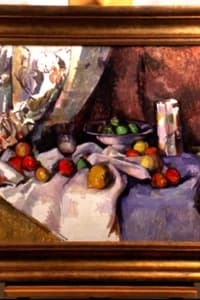
Following his use of art, painting and sculpture, in his work of the previous decades, Hurwitz took on a project for the American Foundation of the Arts aimed at deepening and enriching, for art students, the way in which we see. Working with his second wife, the editor Peggy Lawson, he made four short films comprising The Art of Seeing Series. The films, made without words, are beautiful poems to the pleasure of sight. This film came as a challenge that Hurwitz made for himself, to replicate in film his experience of seeing a work of art — in this case Césanne’s Still Life with Apples, 1895-98, that hangs in the Museum of Modern Art in New York. Although he finished the visual part of the film, he was stymied by the soundtrack in which he wanted no narration. About 45 years later, his colleague, Manfred Kirchheimer, created a sound track and produced the finished film.
poster
?

National Hunger March 1931 (1932)
A document of the 1931 national hunger march on Washington produced by the Workers Film and Photo League.
poster
?

America Today (1934)
One of the key works in creating the American social documentary film, this 1934 newsreel compilation crams a lot of information into just 11 minutes. Skillfully edited, the picture captures a panorama of international events centered on the labor movement. Scenes include Mussolini, Hitler and FDR preparing for war, Nazi soldiers persecuting German Jews, a political strike in Paris, the Scottsboro demonstration in Washington, DC, police violence against striking steelworkers in Pennsylvania and union members stopping scab workers from delivering milk during a dairy farmers strike in Wisconsin. Under the direction of pioneering documentarian Leo Hurwitz, the images are edited together to create a powerful image of a world that, in his view, desperately needed radical change.
poster
?

Detroit Workers News Special 1932: Ford Massacre (1932)
The only known film record of the mass march and meeting held in Detroit on Feb. 4, 1932, against hunger and unemployment. Also shows the dramatic demonstration by workers at the Ford auto plant in River Rouge, Michigan in March of 1932, which ended with a violent attack by Dearborn police and Ford Company guards on the crowd with clubs, tear gas and guns which killed four young men. These deaths set off a wave of protest across the country.
poster
?

Bonus March 1932 (1932)
Bonus March shows unemployed WWI veterans marching on Washington, D.C., demanding their bonus money, and being forcefully evicted.
poster
?

Hunger: The National Hunger March to Washington, 1932 (1933)
A document of the 1932 national hunger march on Washington produced by the Workers Film and Photo League.


mdblist.com © 2020 | Contact | Reddit | Discord | API | Privacy Policy