mdblist.com logo The Best Katia Kameli Directed Movies


Ratings
Between
and
Between
and
Between
and
With at least
votes
Between
and
With at least
votes
Between
and
With at least
votes
Between
and
With at least
votes
Between
and
With at least
votes
Between
and
With at least
votes
Between
and
With at least
votes
Between
and
With at least
votes
Additional filters
m
Lists, Streaming Services, Cast and more
Create List (7 items)

Login to create Trakt list


poster
?
25
/2/
50
/1/

Nouba (2000)
Nouba plays on the aesthetics of video clips and evokes a remote and exotic reality, further displaced by an unterritorialized music. The word "nouba" is borrowed from Maghrebi Arabic "nuba", which in classical Arabic is sais "nawba" meaning «in turns» or «to succeed each other». This word has integrated the French language through Algeria’s colonial army describing the Algerian infantrymen’s music before shifting again to become a synonym of partying. This title is also a hommage to Assi Djebar’s film La Nouba du Mont-Chenoua (1977), the first algerian feature film made by a female director which key protagonist is an emancipated Algerian woman.
poster
?

Dissolution
This video takes a particular viewpoint, with the camera placed behind a zone of blur. Slowly, we experience the perception of an expanded time. An expectation is created and resolved in the observation of the passage of boats that dissolve into the nebulousness, disappearing from our sight like a mirage.
poster
?

The Algerian Novel (2019)
Starting from a small kiosk of old postcards as a derisory memorial of Algerian history, the visual artist questions the role of images - or the absence of images - in the representation of the colonial heritage of Algeria, of decolonization and the dark years… in short, in the construction of his national novel. In three separate chapters, Katia Kameli delivers a reflection on the making of images or symbols (the flag!). In the enlightened company of the philosopher Marie-José Mondzain and extracts from films by Assia Djebar, she begins a critique that goes beyond the Algerian framework on our relationship to the stories, ideologies and images that shape them.
poster
?

The Algerian Novel, chapter 2 (2017)
In Algerian Novel - chapter 2, French philosopher Marie-José Mondzain reinterprets Algerian Novel - chapter 1. The film’s nested structure is a way to keep images and their symbolic load at a distance. It opens a new space of negotiation wherein new associations can be shaped. They function as a starting point for the writing of a history in movement and produce narratives which then become touchstones for a new kind of historicisation. In the second part of this second chapter, Mondzain analyses another visual material: that of the rushes recorded during the shooting of the first chapter. These rushes could have been left invisible, or rather 'unseen'- the same way some of the Algerian’s historical figures are not represented on the pictures of the kiosk. In her book, L’image peut-elle tuer? [Can the image kill?], Mondzain defines the 'unseen' as what is waiting for meaning in the community debate. The unseen would then be a sort of unexploited archive, waiting for the gaze to expand.
poster
?

The Algerian Novel, chapter 3 (2019)
The Hirak protests appear as a counterpoint to the investigations conducted throughout the film, and seem to provide the gateway to the exploration of hidden memories. Through a discussion on Louiza Ammi's photographic work, this chapter is an opportunity to rectify the iconographic absence of the Black Decade, which is mentioned in the first two parts. The analysis of sequences from the Assia Djebar's movie La Nouba des femmes du mont Chenoua, by Ahmed Bedjaoui, producer and film critic, feeds into this historical reinvestment. This film, which is symbolic of the beginnings of post-decolonization Algerian cinema, reappropriates the writing of history through the prism of women of different generations, whose words embody a memory that is too often overshadowed.
poster
?

The Algerian Novel, chapter 1 (2016)
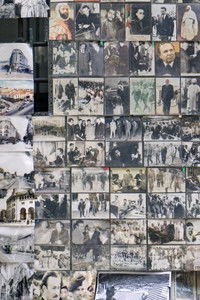
In Larbi Ben M’Hidi street, in Algiers, Farouk Azzoug and his son own a nomad kiosk where they sell old postcards and reproduction of archival photographs. Many different images constitute this fund, going from the late 18th century until the 1980’s. There can be found original postcards, of genre scene or architecture, art deco commercials for the railways, and also photographic reproductions of important political figures from or coming to Algeria. This eclectic collection - good neighborly displayed under plastic - brings us into a colonial and postcolonial iconography. It appears to be classified randomly but it allows many associations, as a kind of Algerian Atlas Mnemosyne. Over the images of the kiosk and different locations in the city, we can hear the voices of inhabitants of Algiers, historians, writers, students, who explain their connection to these images and to the history of their country.
poster
?

Bledi a possible scenario (2004)
Throughout the video, image, sound and language (spoken, sung or written – on street signs or in the subtitles) are combined, and re-combined, to reveal ‘Algeria’ as a site of competing discourses, a culture in the constant process of ‘becoming’ (Stuart Hall 1990). We are presented with fragments of individual yet intersecting micro- narratives – alternative, partial, local perspectives, which together counter the persistently reductive, totalising images of Algeria in certain Western media.


mdblist.com © 2020 | Contact | Reddit | Discord | API